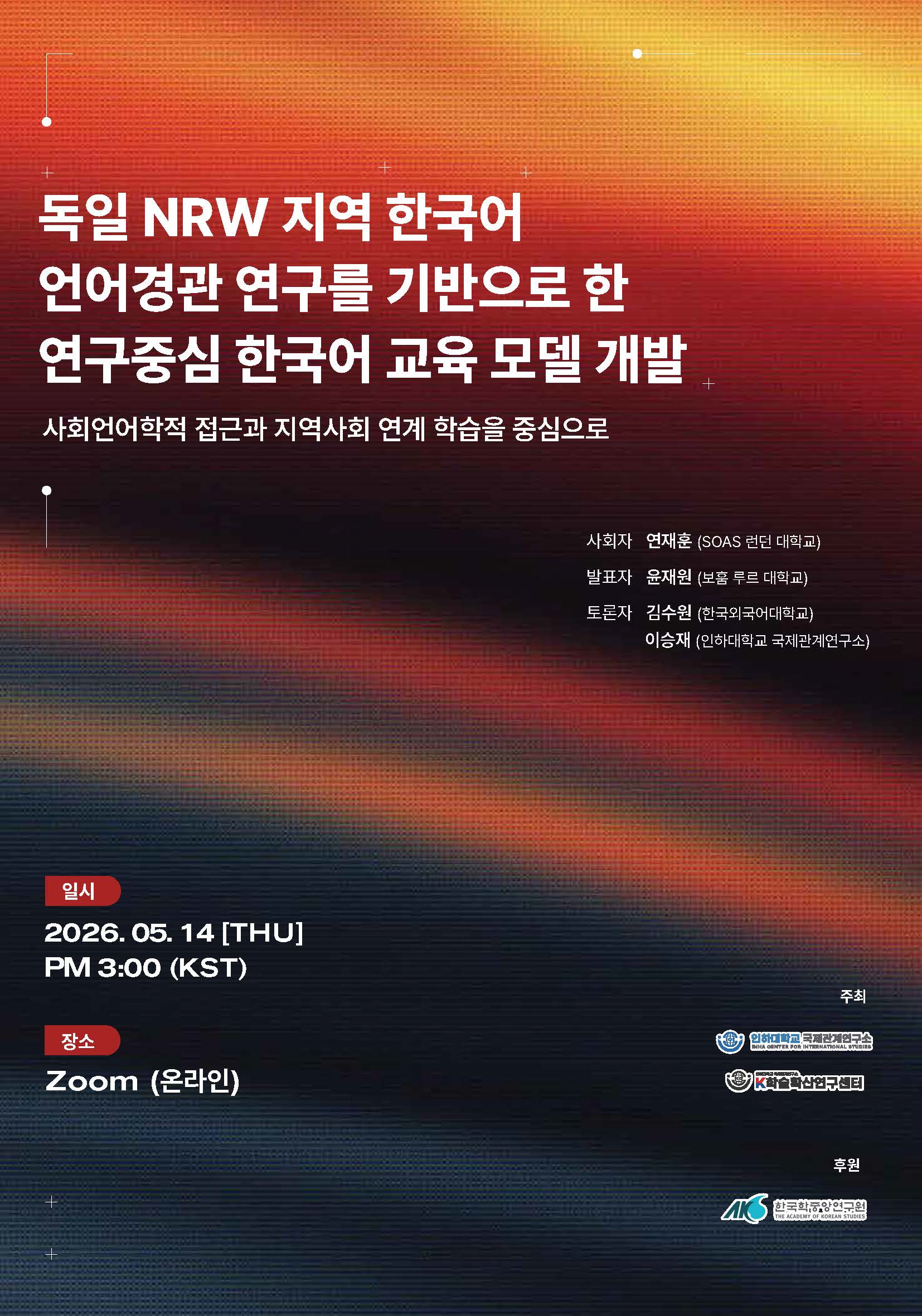
Development of a Research-Oriented Korean Language Education Model Based on the Study of the Korean Linguistic Landscape in Germany’s NRW Region
Created 2026.05.19
PresenterJaewon Yoon
Views24
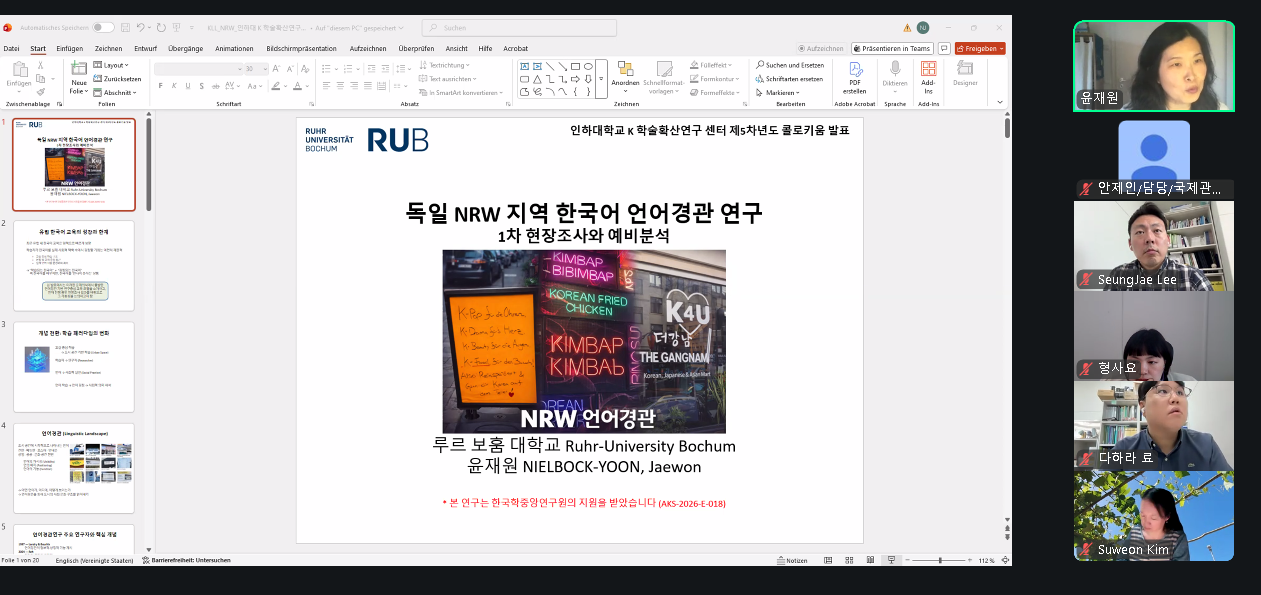
The K Academic Diffusion Research Center at Inha University held its 5th-year colloquium, featuring a presentation by Professor Jaewon Yoon of Ruhr University Bochum titled “A Study of the Korean Linguistic Landscape in Germany’s NRW Region: Preliminary Field Research and Analysis.” The colloquium explored the visibility and social significance of the Korean language in Europe.
The presentation introduced the results of a field study on the Korean linguistic landscape in the Nordrhein-Westfalen (NRW) region of Germany. It began from the recognition that, despite the quantitative growth of Korean language education in Europe, learning still largely remains confined to classroom- and textbook-centered structures. Based on this awareness, the presentation proposed the possibility of a research-oriented educational model that transforms urban space itself into a site of education and research, positioning learners not merely as language learners but as researchers who interpret language within urban environments.
The presentation also introduced fieldwork conducted in major cities of the NRW region, including Düsseldorf, examining the visibility and symbolic meanings of Korean language usage in signs, menus, posters, and commercial spaces. In particular, discussions focused on how Korean is consumed and reconstructed within multilingual urban environments where Japanese, Korean, Chinese, German, and English coexist.
In addition, the presentation introduced digital humanities research methods utilizing ArcGIS and Survey123 to accumulate and visualize linguistic data as spatial data. A research-and-education integrated model, in which students directly participate in field research and data interpretation, was also presented.
The discussion session was moderated by Emeritus Professor Jaehoon Yeon of SOAS University of London. Professor Suwon Kim of Hankuk University of Foreign Studies and Researcher Seungjae Lee of the Inha Center for International Studies participated as discussants. They discussed topics such as the relationship between linguistic visibility and actual language learning outcomes, the symbolic commodification of Korean, methodological challenges in digital humanities-based research, and the relationship between diaspora history and urban space.
In particular, the discussion raised questions regarding how the visibility of Korean within urban spaces relates to actual Korean language learning experiences and social influence, as well as whether Korean in Europe functions primarily as a language of information delivery or as a symbolic sign associated with K-culture consumption. Various perspectives were also shared on how linguistic landscape research could be connected in the future to diaspora studies, public diplomacy, and Global Korean Studies.
This colloquium presented a new perspective on Korean not simply as a classroom language, but as a social language embedded within European urban spaces. It also served as an academic forum for sharing interdisciplinary research possibilities linking linguistic landscape studies, digital humanities, Korean language education, and diaspora studies.