International Conference
International Conference
2026-27 Inha CIS K-Adademic, 1st Colloquium
- Created 2026.08.19
- PresenterJune Hee Kwon
- Views152
Migration, Borders, and Dreams: Departures, Belonging,
and Intersecting Aspirations among Korean Chinese Migrants
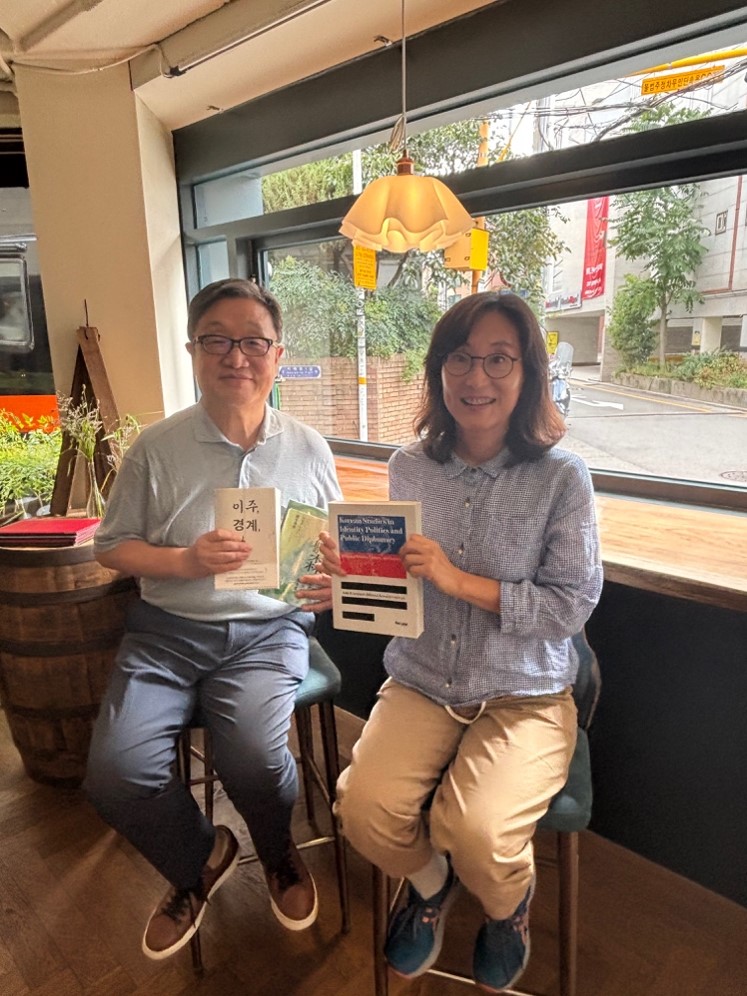
The K-Academic Diffusion Research Center at the Inha Center for International Studies held its first colloquium of the first year on Thursday, August 13, under the theme “Migration, Borders, and Dreams: Departures, Belonging, and Intersecting Aspirations among Korean Chinese Migrants.” The colloquium featured a presentation by Professor June Hee Kwon, Associate Professor of Asian Studies at California State University, Sacramento, who examined the transnational lives of Korean Chinese migrants, focusing on their experiences of departure and belonging and the intersecting aspirations that shape their lives across borders. The event also addressed the current state of Korean Studies in the United States and future directions for its development and dissemination.
Professor June Hee Kwon is currently an Associate Professor of Asian Studies at California State University, Sacramento. Her research focuses on the Korean diaspora, transnational migration, borderlands and political ecology, gendered labor, and class formation, with broader interests in the postcolonial and post-Cold War political economy of East Asia. Her 2023 book, Borderland Dreams: The Transnational Lives of Korean Chinese Workers, published by Duke University Press, is based on more than a decade of fieldwork in Seoul and Yanbian and examines the “Korean Dream” among Korean Chinese migrants through the lenses of bodies, money, and time. The book received the 2024 Francis L. K. Hsu Book Prize from the Society for East Asian Anthropology (SEAA).
In her presentation, Professor Kwon examined the experiences of “departure” and “belonging” among Korean Chinese migrants moving between China and South Korea. She emphasized that these experiences cannot be understood simply as physical movement or settlement, but must be understood through the intersection of family, labor, economic opportunity, and identity. Focusing on the relationship between the “Korean Dream” and the “China Dream,” she explored how the aspirations and strategies of Korean Chinese migrants have changed amid broader social and economic transformations in China and South Korea. Their experiences, she argued, provide an important lens for understanding migration, labor, identity, and political economy in East Asia.
The colloquium also discussed the current state and future development of Korean Studies in the United States. As teaching and research on Korean history, politics, society, culture, and language continue to develop at American universities, the discussion emphasized the importance of connecting Korean Studies with broader academic fields and research agendas, including migration, diaspora, labor, identity, and political economy. In particular, incorporating the experiences of overseas Koreans and diaspora communities into Korean Studies can expand its academic and geographical scope while creating new intellectual connections between Korean Studies and American academia. At California State University, Sacramento, for example, the Korean Studies minor approaches Korea from an interdisciplinary perspective, covering areas including Korean art, culture, history, philosophy, and politics, while also encouraging the study of the Korean language.
The event further highlighted the importance of two-way knowledge circulation between Korea and overseas academic communities. Connecting research produced by overseas Korean scholars with Korean Studies in Korea through translation, publication, and sustained academic exchange can provide an important foundation for developing Korean Studies as a global field of knowledge.
This colloquium was significant because it expanded Korean Studies beyond a territorially centered, culture-oriented approach to encompass migration, borders, diaspora, and the political economy of East Asia. By bringing together the experiences of Korean Chinese migrants and the current state of Korean Studies in the United States, the event provided an important opportunity to explore how overseas Korean research and international academic networks can contribute to the continued development and dissemination of Korean Studies in the United States and its growth as a global field of knowledge.