


International Conference
International Conference
2026-27 Inha CIS K-Academic, 3rd Colloquium
- Created 2026.11.23
- PresenterDr. Jaewon Nielbock-Yoon
- Views13
On Thursday, November 19, 2026, from 3:00 to 4:30 p.m., the K-Academic Diffusion Research Center of the Inha Center for International Studies hosted its third colloquium of the year online. The colloquium featured a presentation by Dr. Jaewon Nielbock-Yoon of the Department of Korean Studies at Ruhr University Bochum, titled “Expanding the Horizons of Korean Studies: Student Learning and Growth through Research and Public Engagement,” which examined the educational outcomes of a Korean linguistic landscape project in Germany’s North Rhine-Westphalia (NRW) region.
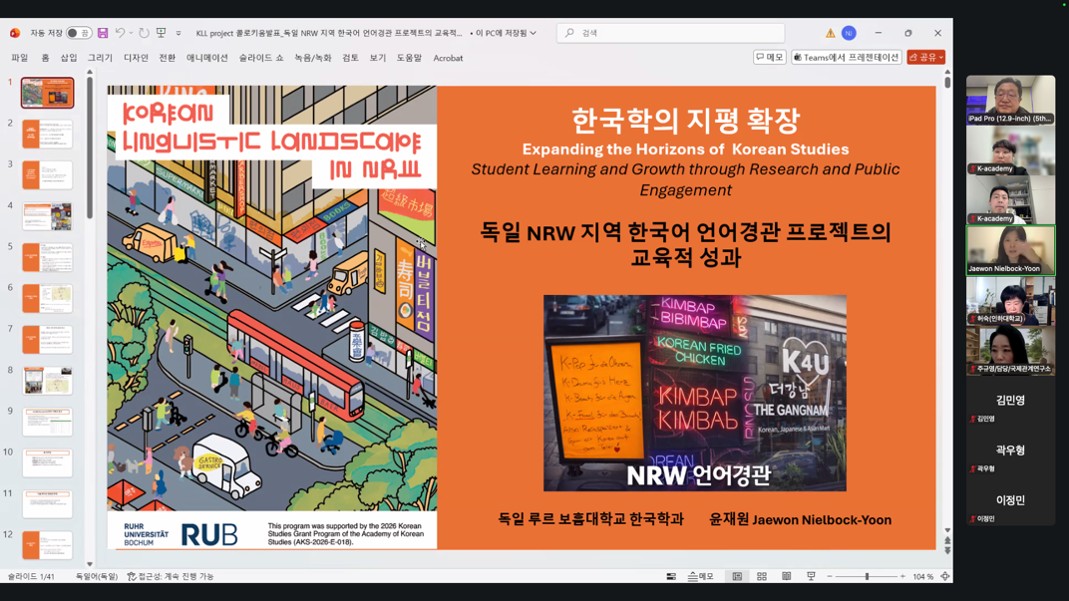
The presentation began from the observation that while the number of Korean learners in Europe continues to grow, opportunities to encounter Korean outside the classroom remain limited. To address this gap, Dr. Nielbock-Yoon introduced a student-led project that brings linguistic landscape research, the study of how language and signs appear in urban space and what they mean socially, into Korean language education, positioning students as field researchers and communicators of public knowledge. Students surveyed 110 Korea-related sites across eight NRW cities, conducted surveys and interviews with German speakers, Korean learners, and Korean speakers, and mapped their findings using ArcGIS.
The project found that nearly half of the Korea-related sites were concentrated in Düsseldorf, and that Korean visibility extends well beyond Hangul, appearing through romanized names, food vocabulary, business names, visual symbols, and product packaging in mainstream retail stores. Because the same sign can be read differently depending on the viewer’s language knowledge and experience and on the history and context of the place, Dr. Nielbock-Yoon argued that the meaning of Korean takes shape through the relationship between sign, place, and viewer.
The presentation also described how students took part in every stage of the research, from framing questions to fieldwork and data interpretation, and shared their findings with the wider community through Ruhr University Bochum’s Teachers’ Day, attended by some 250 NRW teachers; English- and German-language presentations at libraries in Düsseldorf; an on-campus exhibition; and a radio broadcast. The findings were also turned into a special issue of Jam Korean, a magazine for Korean learners, and a book produced by the students themselves.
The discussion was moderated by Professor Jean Young Lee, Director of the Inha Center for International Studies, with Research Fellow Sook Heo of the Center for Multiculturalism and Social Integration, which operates under the Inha Center for International Studies, serving as designated discussant. Dr. Heo praised the project for extending Korean language education from the classroom into everyday urban space and for helping learners grow into researchers and communicators of public knowledge. She asked how Korea-related sites without Hangul were selected for analysis, how gains in motivation can be distinguished from actual language improvement and whether pre- and post-project assessments were conducted, and whether a common assessment model could be developed for use at other institutions. She also suggested ways to apply such a project to education for international students and to social integration programs for immigrants in Korea. The Q&A session covered the design and operation of the student-led course and the value of analyzing the visibility of the Korean language separately from the visibility of “Koreanness.” Dr. Nielbock-Yoon noted that the standardized ArcGIS survey framework developed for the project can be used in other regions without modification, and shared her vision of extending the survey across Germany and to cities throughout Europe. Participants also discussed possibilities for collaboration with the Inha Center for International Studies, including follow-up research and co-authored papers drawing on the extensive data collected, as well as sharing the teaching concept the team developed for secondary schools.
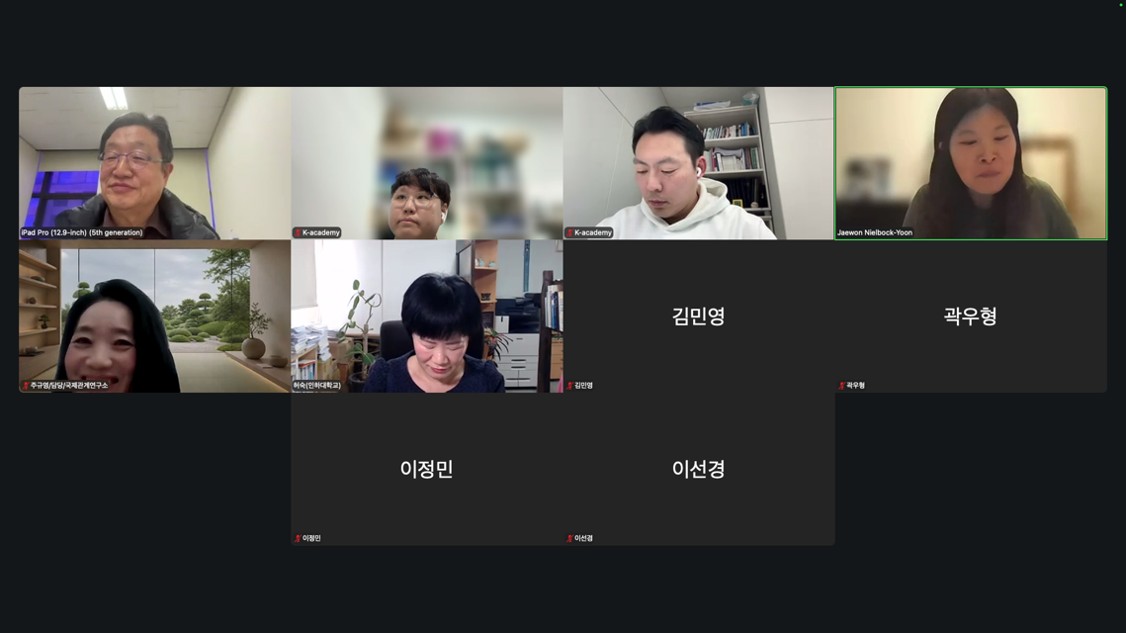
The colloquium highlighted new possibilities for Korean Studies education abroad, in which research, teaching, digital technology, and public engagement work hand in hand. It also offered an opportunity to explore ways to strengthen the educational foundations of Korean Studies in Europe and deepen its ties with local communities, while opening the door to future collaboration in disseminating Korean Studies abroad and pursuing international joint research.